Patenting Process
A patent is issued by the US Patent and Trademark Office, granting a temporary monopoly of the invention, in exchange for a full disclosure of the invention.
A patent is issued by the US Patent and Trademark Office, granting a temporary monopoly of the invention, in exchange for a full disclosure of the invention.
A patent is an enforceable writ providing inventors rights to practice their invention while restricting competitors from appropriating the invention, or practicing embodiments of the invention, without licensing the invention from the inventor.
A patent is issued by the US Patent and Trademark Office, granting a temporary monopoly of the invention, in exchange for a full disclosure of the invention. The temporary monopoly granted an inventor is offered only in exchange for a full disclosure of the invention. A patent is, therefore, not an award for an inventor’s novel discovery, rather it is a tool used to effect disclosure of inventions for the public good.
To secure your patent you must “enable” your invention in a patent disclosure. “Enablement” means that any person having ordinary skill in the filed of your invention would be able to practice the invention from reading the patent disclosure alone.
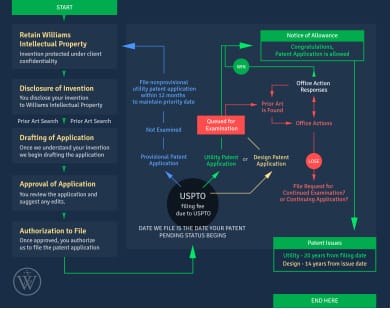
Summary of the patent process

Example time line establishing a date of priorty by filing a Provisional Application for Letters Patent
Approve the application, and authorize Williams Intellectual Property to represent you before the USPTO and file your patent application to secure patent pending.
• For utility and design applications, the application is queued in the Patent Office. It may take more than 18 months for a response to issue from the USPTO. Williams Intellectual Property will argue any Office Actions issued from the USPTO until prosecution on the application is closed, and the patent issues or is abandoned.
• For provisional applications, remember you have 12 months to effect a utility filing to maintain the priority of the provisional’s filing date. Failure to file the utility application within 12 months will result in the provisional application’s abandonment. For an example of a priority date established between a provisional application and a subsequently filed utility application, please refer to the time line below.
Utility patents offer the broadest protection for any new or useful process, machine, manufacture, or composition of matter.
Learn moreDesign patents protect the way something looks, not the structural components informing the device.
Learn moreA provisional patent is a temporary filing, filed under 35 USC 111(b), used to secure the benefit of a filing date.
Learn morePlant patents are granted to an inventor who has invented or discovered, and asexually reproduced a distinct and new variety of plant.
Learn moreLorem ipsum dolor sit amet, consectetur adipiscing elit. Aenean euismod bibendum laoreet. Proin gravida dolor
Learn moreLorem ipsum dolor sit amet, consectetur adipiscing elit. Aenean euismod bibendum laoreet. Proin gravida dolor
Learn more